
Kleeblattschädel Syndrome. Case Report.
Dr. Axel Cruz Martínez, Specialist registrar in Anaesthesia; Dr. Katia Teresa Mazaira Avila, Specialist registrar in Anaesthesia
Lic. Onaivis Carrillo Toirac, Nurse anaesthetist
Department of Anesthesia and Resuscitation, Pediatric Hospital Juan Manuel Márquez
La Habana, Cuba.
Summary
Kleeblattschädel syndrome or cloverleaf skull is a malformation cranial severe very rare. It’s caused by the premature closure of the sutures, coronal, sagittal and lamboidea, to since before the birth. Its surgical approach is combined; the surgical team consists of anesthesiologists, neurosurgeons, maxillofacial surgeons and esthetic surgeons, a requiring several interventions programs in several stages. The anaesthetic considerations include the main challenges to estimate the blood lost during the surgery, the establishment of saving methods of blood, the maintenance of hemodynamic stability and the reduction of the requirements of blood allogeneic.
Key Words: syndrome of Kleeblattschädel, considerations anaesthetic
Introduction
Kleeblattschädel syndrome or cloverleaf skull is a malformation cranial severe very rare. It’s caused by the premature closure of the sutures, coronal sagittal and lamboidea. In the most serious forms, the ballooning bilateral skull in the regions temporary and at the top induce a shift downwards the ears, which have face to the shoulders. There may be exophthalmia linked to the swelling of the orbits and an inability to close the eyelids, causing ulceration of the cornea. Have been described other signs: hypertelorism, flattening of the birth of the nose and hypoplasia of the center of the face. It has also been described a distended vein in the sclera and scalp. There is often a hydrocephalus associated, as a result of the obstruction of the aqueduct cerebellar with an increase in the intracranial pressure that requires a ventricle peritoneal shunt. They have often described malformations of the brain and the cerebellum. Its main complications are the psychomotor retardation, alterations in the vision, difficulty breathing and feeding.
Their treatment is eminently surgical in the search for achieving the normal growth of the brain and facial structures. Its surgical approach is combined; the surgical team consists of anesthesiologists, neurosurgeons, surgeons maxillofacial and aesthetic surgeons and requiring interventions programmed in several stages.
Case report
We report a female patient of 3 years old and 15 kg, with Kleebattschädell syndrome, as a result of the disease was necessary performed peritoneal ventricle bypass, choanal atresia incomplete by which was necessary tracheotomy, bronchial asthma and electroencephalogram pathological.

Fig. 1
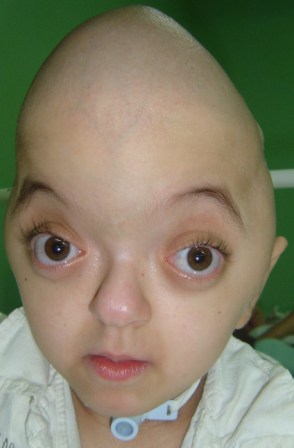
Fig. 2
Surgical intervention proposal and carried out was: transposition of bone frontal and parietal, craniotomy and multiple bones fragmentation.
Preoperative test
Hemoglobin: 116 g/L
Hematocrit: 0.35
Time of bleeding: 1.5´
Clotting Time: 9´
Prothrombin Time: control 14´´ patient 15´´
Platelet count: 200 x 109/L
Pre anesthetic medication was performed with Betamethasone 2 mg, Dipyrone 450 mg, Midazolam 1.5 mg, Vancomycin 250 mg. Induction of anesthesia was performed with Atropine 0.2 mg, Fentanyl 45 mcg, Ketamine 2 mg, Vecuronium 2 mg, Propofol 45 mg. During induction withdrew the cannula tracheotomy and she was intubated with a TET No. 4.5 with cuff, which was inflated with 1 ml of air, in order to avoid the risk of pulmonary aspiration of swallowed blood from the surgical field. Anesthetic maintenance was provided with O2 50 %, compressed air, Isofluorane to 1.2 %, infusion of Ketamine to 3.5 mcg/kg/min, bowling Vecuronium 0.5 mg.
Performed collision of femoral vein right with a catheter double light, two peripheral veins was channelled with cannula 20, hers monitored was cardiac frequency, tension arterial, electrocardiogram, vein central pressure, oxygen saturation , pletismográfica wave, capnography,, temperature, dieresis and ventilators parameters, maintaining stability hemodynamic throughout the intervention.
Complementary intraoperative
|
1 |
2 |
3 |
|
Arterial blood |
PH |
7.26 |
7.28 |
7.34 |
Pco2 |
51.1 |
43.6 |
48.2 |
|
Po2 |
381.2 |
114.8 |
333.7 |
|
So2 |
99.9 |
97.5 |
99 |
|
EB |
-4.6 |
-6.5 |
-0.4 |
|
SB |
22.5 |
20.1 |
25.7 |
|
Ionogram |
Na |
142 |
142.4 |
140.1 |
K |
3.81 |
3.93 |
3.71 |
|
Glycemic |
8.0 |
-------- |
11.5 |
|
Hemoglobin |
-------- |
-------- |
8.7 |
|
Other medicines administered during the intraoperative were: mannitol 4 g, acid epsilon aminocaproic 2 g, sodium bicarbonate 4 % 5 ml and betamethasone 2 mg.Intraoperatively was necessary transfusing red blood cells 500 ml.

Fig. 3

Fig. 4
At the end of the surgery moves sedated and intubated with controlled ventilation toward the pediatric intensive care unit, being extubate the next day.
Discussion
It is recommended early surgery, preferably in the first six months thus avoiding subsequent complications. The surgery involves the revamped the skull through multiple osteotomies with repositioning of the bones and fixing of these with plates or bone grafts.
The anaesthetic considerations include a careful preoperative evaluation, its important to make the calculation of the perioperative blood lost, arises that potentially in this type of surgery will be between 50 to 100 % of the volemia, recommended the establishment of saving methods of blood from is being planned surgery (1), blood products should be available (2), the preoperative test include the determination of hemoglobin, hematocrit and studies of the clotting.
The conduct anaesthetic during the perioperative is moving toward a comprehensive observation bleeding and its impact on hemodynamics and domestic environment.The excessive bleeding is produced by injury of the breast venous brain; it’s the most serious complication and its impact on hemodynamia and domestic environment. It will seek to maintain the volemia with crystalloids, colloids and with savings measures of blood to reduce the needs of homologous transfusion as well as to reduce the impact of the administration of blood allogeneic.
The end of the surgery is recommended the move toward the intensive care unit.
Bibliographic reference
- Di Rocco C, Tamburrini G, Pietrini D. Blood sparing in craniosynostosis surgery. Semin Pediatr Neurol. 2004 Dec; 11(4):278-87.
- Orliaguet G, Meyer P, Blanott S. Anesthetic management for craniosynostosis. Ann Fr Anesth Reanim. 2002 Feb; 21( 2):111-8
